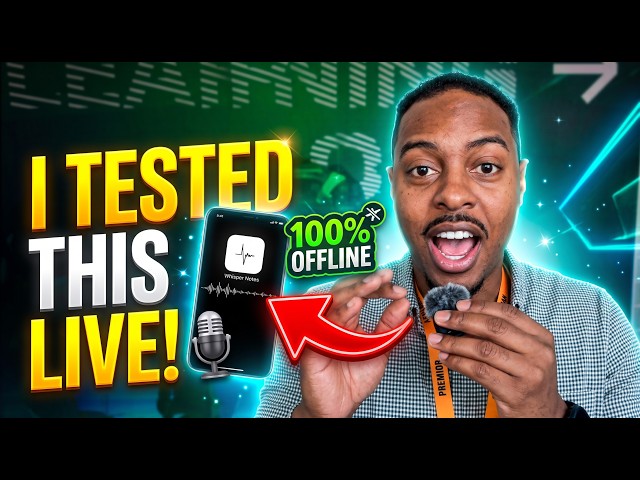
I Tested the Whisper Notes App LIVE at a Conference (Real Transcripts and Audio)
· 2 min read · whisper notes, transcription, ai tools
In the video above, I tested the Whisper Notes app live at a conference by recording real talks and checking what it produced. I said you’d get the full audio and transcript for every talk I showed, and this page is where they live.
Jump to the audio and transcripts below. Each talk has an audio player, the full transcript, and downloads for the audio, a plain-text transcript and an .srt captions file.
My verdict on the app
It works well, and I’d recommend it. The things I like most:
It’s 100 percent local. The transcription happens on your own machine.
One flat fee, and you own it forever. It costs $7.99 as of November 14, 2026, with no subscription.
Mistakes are easy to fix. A few words were transcribed incorrectly, but the app keeps the audio next to the transcript, so you can edit the script whenever you want.
One limitation: it’s only available on iOS right now, so if you’re on Android or Windows, it’s not an option yet.
How to use the players
Press play and the line being spoken is highlighted in the transcript. Leave “Follow along” on and the transcript scrolls with it.
Click any sentence, or the timestamp above a paragraph, to jump the audio to that moment.
Use the download links if you want to keep the audio or search the text in your own editor.
What’s in each recording
Vic Mensa with Simone Tyler. A conversation about Vic’s career and the things happening in culture.
Steve Stoute. A conversation on culture, capital and control, at the point AfroTech was marking 10 years.
Travis Hutchinson and Tim Jurka. A talk about how the LinkedIn feed lets people represent themselves as experts and reflect on nonlinear career paths.
A note on accuracy
These transcripts come from the test itself, so a few words are wrong. Names, product terms and crosstalk are the usual trouble spots. For example, the Steve Stoute transcript hears “AfroTech” as “Afro technical” and “Afro time zone”. Check anything important against the audio, which is exactly what the click-to-seek player is for.
To see how the app handled the live recording, watch the full video and tell me in the comments what you’d test next.
Audio and transcripts
Vic Mensa in conversation with Simone Tyler
A conversation about Vic's career trajectory and what is happening in culture right now.
Simone Tyler Alright, I am excited about today's conversation. How you feeling?
Vic Mensa Me too. I feel good. How are you?
Simone Tyler I'm good. Nervous no?
Vic Mensa No, not really, but I appreciate y'all for having me.
Simone Tyler Alright, just in case we we have some oranges here for you.
Vic Mensa Oh we use it.
Simone Tyler Yes, they're real oranges. I can't confirm if they're organic or not. Like this might not have come. We'll just say they are.
Vic Mensa This is organic, these are from my crew.
Simone Tyler Alright. Mick, thanks so much for joining us today. Alright, so we're gonna have a conversation today about what it actually looks like in your career trajectory, all of the things that are happening in culture. There is a lot going on we had a fantastic week I believe as a people shout out to we're also gonna talk
Vic Mensa about shout out to Texas man Texas showed out and shout out to black women for being the major key.
Simone Tyler Absolutely. You know, we're always gonna show up and show out.
Vic Mensa We trying to catch up. We got some work to do, but y'all always do what needs to be done for sure.
Simone Tyler Alright, you have a very, very expansive career from philanthropy to activism to music to media to advocacy. You now have what I would consider a little media empire. Tell us about what how you built that. How did this start?
Vic Mensa Really it it it came from necessity. About a year and a half ago I had the limitation of not having distribution for my album and I didn't have the money for marketing and so I just bought a camera and said I'll find a way to connect with the people by myself. And so I started learning the Sony FX30 camera and diving into Da Vinci the editing software and just expressing myself, just talking the way I would talk to you in this conversation a little more vulgar though I'm not gonna be all the way high beat but um but with the camera I could be that way and so I I started putting that out myself and I saw that grow into different things.
Vic Mensa First I built it into a a weekly newsletter that's like a subscription model and built it into this orange tree series and then more recently built that into my podcast, The Vic Mensa Show. So it really came from necessity though you know saying I think like one thing I would consistently preach is that it's important to see your limitations and your boundaries as an opportunity for growth and innovation because that served that purpose for me. Not having the money that I felt like I needed forced me to learn different skills and develop different talents and build different businesses.
Simone Tyler Yeah. I think creativity and ingenuity is important for all of us. We've got technologists in the room, entrepreneurs, um, founders, we've got city leaders and civic leaders here. Um what we are learning this week is that technology really gives everybody a platform, especially today, uh, but not everybody uses that technology to build community. And that is a core part of your work. Can you tell us about why you decided to center black communities as your in part of your work and in your conversation?
Simone Tyler Like where did that come from?
Vic Mensa I was telling you backstage that I've been studying a book by Kwame Kruma. Kwame Kruma is the liberator of Ghana. I know we had Afrotech. I don't know if we got any Ghanaians or Nigerians or anything. There's a lot of Nigerians in Texas, right? That's the thing, right? And Kwame and Kruma actually made Ghana to be a socialist state because he said that socialism was the natural evolution of a lot of African societies that practice something called communalism, which emphasizes collective ownership and cooperation, basically black people working together.
Vic Mensa And in studying that, I think that that's like a baseline for a lot of what I do. It's like an appreciation for the people, a belief in the people, and a recognition that only through community do we actually move forward and I'm always seeking to learn and I'm learning from my community constantly. Like I share a lot of information and a lot of knowledge but that's just like as a conduit. It's not because I think that you, know, I'm the one who should have a microphone and be able to speak. It's like because I'm listening.
Vic Mensa You know what I mean? I'm listening like to a lot of black women in my life who are constantly teaching me things that I'm then processing through my own lens and my own information and serving back to the people and and I see myself as being a part of community.
Simone Tyler Yeah, so with that new kind of scale and impact, what is it that you hope to gain when you think you know 10 years from now you're now creating a new platform and expressing yourself in a new way how do you hope that that scales and builds?
Vic Mensa I'm gonna be honest with you, man. I I'm not the biggest like long plan person. I'm a very in and out person and it's not that I I uh don't understand the importance of of a long-term plan, but because I'm just really focused in the now and like putting the pieces together in the best way that I can and try to stay present and not be too consumed by the past or the future, you know, past and future are the robbers of time like I've seen in my own life so many times where I was caught up in what happened before and what might have went wrong and how I felt like I made mistakes that I wasn't able to actualize the present.
Vic Mensa And so right now I think I'm most focused on building things in the present that I believe will still apply to me in the future. Like things that that are are authentic and honest and uh even like the decision with the with the show to call it the Vic Mensa show as opposed to something else something with oranges or something I was like let me try to build something that no matter which way this goes it still applies to me in
Simone Tyler 10 years so yeah absolutely I'm gonna pivot a bit to uh the emerging industries. Right now we're all having conversations about emerging industries, healthcare, civic spaces, AI, obviously. However, in the last 10 years, it's been a huge boost around conversations around cannabis. Tell us more about your entrepreneurship journey in that space and what's your intention as you kind of build.
Vic Mensa About six years ago I launched a company called 93 Boys as the first black-owned cannabis business in Illinois. I'm from Chicago and thank you. That was really necessary for me personally because I lost my big brother there to a senseless murder. He was selling weed. That was like he was a neighborhood pharmacist and he was killed over about a QP when I was 17. And so when the laws began to change, it was always on my mind that, you know, for him and also for the history of cannabis being criminalized because of its association with black jazz musicians and reefer madness.
Vic Mensa These uh these tropes were what allowed them to lock billions of us up through the war on drugs and system of mass incarceration. Now that cannabis is legal, I mean we're less than 4%, sometimes less than 1% of the industry. So I do think it's like important that we lay claim to what I believe is ours. Like we have a deep understanding of the land. We've always been the people that that lives from the land, that finds healing and medicine through the land. And you know, the cannabis industry, it it owes us.
Vic Mensa Like they owe us career.
Simone Tyler Yeah, thank you for that. And you've spoken about a lot of issues from school to prison pipeline to humanitarian crisis around the world. You help people understand, can you help us understand how these are not in silos, that they're not isolated issues? I think when we're talking to mayors and politicians, especially in this year, we realize that a lot of this is actually interconnected.
Vic Mensa One thing I'm always preaching is like an end to the diaspora wars because when you lift up the hood of the vehicle you realize that the same engine that's oppressing black people in Texas is oppressing black people in Chicago is oppressing them in Nigeria in Ghana and South Africa, you spoke about mass incarceration. One specific instance I always point to is a company called Geo Group. Geo Group is one of the largest private prison facilities or companies in America. Not only does Geo Group incarcerate thousands, hundreds of thousands of black people here in America, they also have facilities where they're incarcerating people in South Africa.
Vic Mensa Not only is Geo Group incarcerating us in South Africa. They also own the ICE detention centers where they're incarcerating immigrants of of all races, a lot of Latinos, Haitians, like across the board. It's the same company. So while it's true that we have our own unique uh experiences and our own differences and our cultural specificities, when you look at our shared enemy, I think it only serves them for us to be separate, for us to be divided.
Simone Tyler Yeah, so how do we do that though? I think that's one of the questions we have been trying to navigate through, right? There's so many communities that we say, yes, we need to work together, we need to partner together, we need to figure things out. We just voted for politicians and seat and now it's time for them to govern. What does it look like for us to work as a community in a full ecosystem and actually drive organizations like that to make change or to be gone.
Vic Mensa Definitely grassroots on the ground organizing, but I also think it takes conversation like no real relationship can be based on a foundation of lies or sweeping things under the rug. Like we have to talk about the fact that there's a a deep anti-black American sentiment amongst Africans of the diaspora. We also have to talk about the fact that people in America have been miseducated to believe that Africa is just in poor, impoverished, inferior place. Like we've been sold these false narratives about each other and we don't get to collaboration without addressing it like addressing the actual harms done but looking at the bigger picture at the same time like when you take a historical lens and you look at all of our North Star heroes from Martin Luther King and Coretta Scott King who were actually at Ghana's independence ceremony when Ghana first became the first nation in Africa to achieve independence.
Vic Mensa They were there. Angela Davis, Malcolm X were huge Pan-Africanists. You know what I'm saying? Like our our best have always known that we are to be united. I think that the conversations online they get loud and they're often like uh coming from a pretty disingenuous place and then like when Ukraine strikes down a Russian data center, a lot of those bots go silent because there's actual technology being weaponized against us to keep us in fighting. Like that's a real thing. But I think we get there by by education.
Vic Mensa I mean by by actually knowing the depth of of our situations. Like I've been thinking a lot about this kid, uh Jarvis Rampong, a Ghanaian kid who was killed in the Bronx and uh, you know, it's like a, you know, just a horrendous murder. He's 15 years old. It's like, it's gut-wrenching. But at the same time, in the response, I'm seeing a lot of just regurgitated anti-black American talking points. You know, oh, this is a r result of black Americans not educating their children well enough. If you have the information and you know that systems of mass incarceration and biochemical warfare in the form of crack cocaine have been intentionally used to destroy and destabilize the black community and continued disinvestment leads you to a place where the Bronx is full of 15-year-old kids that kill each other regardless of their ethnic backgrounds because they don't see themselves as having a future.
Vic Mensa But if you know that, then I think you approach it from a different perspective. So I feel like a lot of what I do is in a way like trying to spread that information so that it's like meeting you where you at and and and having the conversation so we can get on the same page.
Simone Tyler Yeah, absolutely. Thank you for that and thank you for the work because I don't know if y'all are following and watching the podcast, but I think it's important, especially because we spend so much time on our phones and we get our news from the phone that we have trusted sources and we trust you.
Vic Mensa For sure.
Simone Tyler All right. Just like no.
Simone Tyler You talked a little bit about limitations around career. This is one thing that obviously a lot of our community is navigating through as they're navigating through what does the future of work look like in technology, what does the future for AI look like and how that impacts our roles and our lives. You kind of mentioned navigating that through creativity and navigating that through new ways. Let's dig into how, what are your feelings and approaches around AI musicians. You're a musician, you're creative, there are people who are creating, you know, songs and things in 10, 15 minutes, things that take you different amounts of time to do in a studio.
Vic Mensa AI music is a complex double edged blade because on one hand it's the final form of the music industry exploitation of black people. They've been trying to find a way to make black music without involving us for a long time. I mean if it's like you listen to all forms of pop music not only do they all come from black music and from the music of the black church but also now they've just adopted the exact styles of like things UGK was doing 20 years ago. The drum sounds that Pimpsy was using 20 years ago is now what you'll hear on like a Sabrina Carpenter song or something.
Vic Mensa But with AI music, you see that they finally found a way that they can make black music and take black people completely out of it. So so that's like horrendous exploitation. But at the same time, with AI as a whole, I mean, if we're not involved in it, it can only be weaponized against us. Because I don't think human history would show you any precedent for a technology that makes humans this more efficient that gets turned off because it's inhumane. We live in an inhumane society. Like this is probably the nucleus of inhumane behavior on the planet, the United States of America.
Vic Mensa So I think if if black people are not at the forefront and creating their own AI systems and technologies with us in mind that aren't building data centers in Houston or Memphis or Gary, Indiana that you know aren't systematically destroying our community. All we can do is be victimized by AI. It's not gonna stop. Like AI is not going anywhere. If we choose to conscientiously object and say like we're not gonna participate, it's not just gonna stop moving. It's just gonna move without us more. And so I do think it's important for for black people to uh be be trained in these models because yo one crazy thing I found out was like AI uh facial recognition software is being used by Palantir in collaboration with local police departments that are uh identifying wrongfully accused black people to incarcerate because it's racist people making the models.
Vic Mensa If you only let racists make the models, all it can do is enact racism upon us. You know what I'm saying? If we don't have anti-racist models of AI that are that are built by us, with us in mind, you know, all we can do is be impacted negatively by it.
Simone Tyler Yeah, what would you say the creatives and uh we have a lot of creators in the house this week. Uh we're doing a creator summit tomorrow and oftentimes I think new creators, especially musicians and people who make film, right, uh, they're oftentimes maybe discouraged a bit by the acceleration of AI and just don't know if their natural talents or natural eye, their music that comes from their soul is going to be seen in the same way. What would you tell them?
Vic Mensa Nothing can ever replace the human element of creativity. At the end of the day, that's what people connect to, that's what people uh you know feel in their bones. Like they might party to a AI song that they don't know like somewhere on a on a cruise or something like that, but what's really gonna keep people coming back is real stories from real human beings. Um I would say use it as a tool, you know what I'm saying? I don't think that uh first of all living your life or fueling your creativity from a place of fear is going to serve you ever.
Vic Mensa But also like AI can be used as a wonderful tool creatively, especially if you're a multi-hiking or something, somebody that does does a lot of things that it it might be able to help you generate some of your visual concepts that you don't have the budget for right now. It might be able to help you flip a sample in a way that you won't have to clear it because you don't have a budget to clear the sample. It might be able to help you repurpose something and just make your process more efficient, you know what I'm saying?
Vic Mensa And I I do think that there's a a a great divide between using AI as a creative tool in your arsenal next to many other creative tools and just approaching it from a place of replacement, I mean, and seeking to replace human beings.
Simone Tyler Yeah, thank you for that. We've seen the name of this this panel is called Sound of Change. We've seen a lot of change in you publicly, obviously as kind of being a bit more public, sharing your voice with us, sharing your knowledge with us, your insight, helping educate us on what's going on in our communities. How have you seen yourself transform and change through this process over the last couple years?
Vic Mensa Man, I would say a lot of transformation for me had to start in silence and definitely in the dark. Like, failure is a great teacher though. Like losing everything and being down to a to a rock bottom, it forced me to develop character and through that to you know really find the things that that drive me in a positive way, like six years ago I guess. I I be I went sober, maybe like five and a half years ago or something like that.
Vic Mensa So shots on me after the um because that's over with but no that helped me a lot and maybe be going sober and like just stopping drinking has been like a it it it's prioritized things a lot for me becoming a father too my son's now two and a half years old and becoming a father trying to be the best partner I could be um all those things like they contribute to anything that you see in me today is because it's like I I understand the weight and the the necessity of being intentional. And all that came though from losing everything.
Vic Mensa Like failure is a great teacher. I don't think running from failure serves you ever. Like I kind of I seek out things that are a little bit too difficult because it's like if I'm trying to to push my limit and doing something that I very well may not be able to accomplish, something I may fail at, then there's a lesson in that. There's always a lesson in failure. Many more lessons in failure than there are in success, because success can mask your mistakes. I mean you can be like, oh, I'm still doing good.
Vic Mensa Man, I made a million dollars this year. I mean, even though I was like, you know, tripping, drugged out and making mistakes and treating people poorly and spending all my money unwisely like I made a lot you know so I'm not so worried about what I did wrong but when you like hit that rock bottom you gotta figure it out.
Simone Tyler What did I just do?
Vic Mensa Like you gotta figure it out for sure.
Simone Tyler Well now you've got the Vic Minta show. We're excited about the podcast. Tell us about what you see. You've interviewed lots of people, but we've also seen you kind of dabble into the political sphere and have politicians on your podcast. Tell us about what you're hoping to gain by being those types of conversations.
Vic Mensa I mean first and foremost I think I just try to go off of inspiration, like be guided by genuine inspiration and and talk to people that I'm interested in having a conversation with, you know? And people I feel like I can learn from. I've talked to so many people that I learned so much from. I don't know if Van Lathan is here right now. I think he's somewhere around, but Van Lathan is just like, you know, one of the smartest people I know. And having conversations with him and people like him on on the show or even like a conversation I had with Lena Waith on the show or I spoke to Alain DuVernay recently.
Vic Mensa It's like people that I can learn so much from. Being guided by that, it it keeps it interesting, keeps it fun for me you know saying um and I know that if I'm learning something then anybody watching is taking something of value from it too and in the process I guess I'm figuring out how to make it like a monetizable business or something that can really provide for my family. Like that's front of mind as well. But I'd be lying if I said I wasn't like primarily driven by the creative of it and just like the genuine inspiration.
Simone Tyler Absolutely. Well VR foodship and sponsorship helps. Yeah.
Vic Mensa Taking sponsors on. That's a that's another thing about it too though is that like you gotta be um you gotta have discernment in this shit because like a lot of the folks that are sponsoring podcasts and content online are actively working to destroy black people. You know what I mean? Like they're they're selling you gambling, they're selling you liquor, they're selling you stuff that as a Muslim, like, it's not even permissible, you know? Uh but that's that's a lot of what you're gonna get is they're gonna be selling you the opportunity to bet on like bombs dropping in Iran today.
Vic Mensa And it's like, I just can't do that, you know? So so I I'm constantly looking for partnerships that make sense with like technology companies and wellness companies and things that are like aligned with me. And it's it's it's harder that way, for sure, but I also recognize that, as you said earlier, so much of what I do is based in community and I know that I have to be accountable to my community. So it's like I can't just be selling you some shit that we both know is bad for you.
Simone Tyler Yeah, absolutely. Absolutely, give it up for that. Um we have a few minutes left. You mentioned you have a two and a half year old, I have an almost two-year-old, and I've been thinking about this a lot this week as it's our 10-year celebration for Afrotech. What world do you want to see for our children? What world can this group of people as their builders and AI technologists and so many doctors and lawyers and so many professionals in this room, what is the world that we want to build towards?
Vic Mensa I had a conversation with Angela Davis one time and
Simone Tyler Oh that's a that was that well you can't just say that. What? I mean you can, but I'm just saying like,
Vic Mensa oh, okay I was gonna ask you a question with an anecdote though and uh she was asked how it felt that the revolution never happened. And her answer was something to the effect of revolution is not judged by its completion, but by its continuation. So when I think about the world I'd like to hand to my son, I I I pray that it's one that continues the work that we're doing now. A lot of what we see around us is regression. You know, like folks voting rights are lesser in many places, especially in the South, than they were when they were born.
Vic Mensa I'm hopeful that we can pass on a world where we we give progress to our kids. You know what I mean? Where being a being a black person in America is less of a target, is less dangerous, is less likely to land you incarcerated for 25 years or murdered by the police. That's something I would love to hand to him. Where there's more health, where one in four of us are not dying from cancer. You know what I'm saying? Like where the diet is improved, where the the general consciousness is is heightened.
Vic Mensa I hope to to hand that to him. But ultimately, I think I can't control that. So I'm focused on doing the the work now so that I've I've done my best to pass it on to them.
Simone Tyler Well thank you so much Dave for this conversation. I really appreciate it. I think that you are a strong example for how we should move from abroad, especially in doing business and what we do business with. So thank you so much.
Vic Mensa I appreciate you.
Simone Tyler All right.
Vic Mensa Much love. Thank you guys. And shout out to Texas, man. Y'all did that.
Steve Stoute: Culture, Capital and Control
A conversation about culture, capital and control, recorded as AfroTech marked 10 years.
All right. How we doing today? Afro technical building, 10 years. Let's go, let's go. All right. I am here with the good friend, the commissioner, Steve Stout. Listen, it's my first time at AfroTime zone. First time? It's my first time, and I'm so happy to be here. Absolutely. I mean, look, me and Steve, I've had the privilege of knowing Steve probably almost 10 years now, maybe a little bit longer, and a lot of the conversations that we've had today or throughout this entire conference are things that we talk about every day.
And that's why I thought it was very fitting just to have this conversation around culture, capital, and control. And especially going into 10 years in Afrotech and how we think about just culture. I mean, you are literally the pioneer when it comes to bridging culture and innovation. And so just to kind of start off with, I think one of the things that you are super, super, super strong on and one of the messages across everything is ownership and I feel like when we're talking about technology, when we're talking about you know founders, starting companies working at the tech these tech businesses, ownership has always been kind of the the core fundamental from your businesses and also how you see the world.
And so just given the fact that not only you've been successful in the entertainment industry, but also in the technology industry too, tell me how you think about ownership in 2026, especially from the this lens today. Well, ownership was something that for a long time, specifically in the music business, the artists never got a chance to own the art. And that it was almost blasphemous if an artist asked to own the art.
Because the the people who would invest in the the artists, whether it be the record companies or some of the patrons of the art, the galleries, they never made the artist feel as if ownership was something that truly mattered. Over time, as technology started to disrupt industries, it was clear that the mode that some of these companies had had before, like distribution and marketing or or um and the financial capital to do that, that those barriers were now democratized and they didn't have that control anymore.
So when I started United Masters, what I wanted to do for the first time was give artists a platform so that they can distribute music and own 100% of the music themselves. It has been a fantastic journey over the last nine years of building this company where we have artists who you may not even know, but because they own their art, they're making seven figures annually. Because of that ownership, and had it been in the 90s, they would have sold that art initially for a couple hundred thousand dollars and then be broke today.
So there was a dramatic dramatic shift in the music industry and as a result of what we started in the United Nations nine years ago if any of you guys are in the music business or paying attention to it, the entire industry now is shifted to that model because the major labels, which for years took advantage of the artists by taking ownership, can no longer offer that as a business model because the artists are refusing and they're saying no. Yep. And then also if you think about now today with the tools from Substack to just even being able to control and own your own own audiences, whether you're starting a company or whether you're, you know, even kind of creating your own businesses now, just really kind of taking that lens and thinking about it from the ownership side first.
And so I mean especially as from a founder standpoint you know one of the things that I I pr particularly found interesting I think that a lot of people in the audience can relate to is your evolution from working in entertainment to going and starting translation, to working in the advertising industry. You know, you were young when you decided to make that pivot and go into an industry where you had understanding, but you never actually had the actual background in and so I mean a lot of people here today are either in extreme either just started a career in technology or interested in moving into the space you know but for people who are unfamiliar with your journey and how uh you got into the advertising business, uh it'd be great for you just to share a little bit more about that.
So a lot of it is betting on yourself. So I want to talk to you. Whether you're an entrepreneur currently or it's something that you aspire to be, the idea of taking the risk embedding it in yourself is a necessary ingredient. So when I was 20, I I grew up in the record business. I worked at Sony Records, I worked with Nas, I managed Mary J. Blige. I was in the industry as a manager and and record executive. And then I went to Inniscope and worked on MM and Enrique Glacius and what you know a a bunch of artists that were super successful.
When I left the music business to go into the advertising business. The reason why I went into the advertising business is because they were just very archaic in the way they seen the world. They actually thought that people were still willing to be spoken to through demographics. So there was African Americans, Hispanics, and other, which was white people, obviously. And and unlike in the music business, it doesn't work that way. Like in the music business, black kids buy MM and white kids buy DMX and it doesn't matter.
Like we don't market it through that channel so why do you do that in communications and in in in in the advertising business thing and then the one thing that was really disturbing was that that let's say it was a $100 million budget, they would spend $13.3 or $13 million of that budget towards African Americans because it was prorated with the population. $13 million, you know, 13% of the population is African American. And I'm like, well, why doesn't somebody, I get that, but why are you measuring African Americans by population and you're not measuring African Americans by their cultural impact.
Because if you measure African Americans by their cultural impact, you'd be spending north of half of your budget connecting with the culture that African Americans influenced. And it was too much staring at me of an opportunity if they thought that was the way to do things, that I could bring innovation of such to that category and I started a company and the name of it was translation and I was going to translate culture for Fortune 500 companies. So I left the music business and I took the instincts that I got from the music business and and brought it into the advertising business and sometimes ignorance is actually the best approach because you don't have any preconceived notions of what you can't do.
And I got into the advertising business and the first thing, and I can go into length about this, but it was work on I'm loving it for McDonald's in 2004 um and you know bringing Farelli to work on the mnemonic um the da-da-da-da-da and having the like but like bringing new ideas and people who actually touched the people to work on this stuff, which was some obviously new to that to that industry. And now, obviously, uh the word culture could not be the most abused term in advertising and you hear it all the time.
But when I said that word in 2004, um no one even knew it. Not even knew, gave it any value. It wasn't valued. And now it's the most valued thing. And then I think, you know, even when you said when you talk about culture, um, not only Ben always says it's culture is a a set of beliefs and it's not you know what you do it is but it's what you do is who you are and so when you think about culture especially when you're starting businesses and when you're thinking about things, you always say that the you said that the core ingredients require three things when starting a company or having a business, which is culture, you need technology, and then you also need to incorporate storytelling.
And so that's literally, if you think about your trilogy of companies that you've you've been able to in your entire career. Convergence of those things. I believe that whatever you're building, the convergence of culture, technology, and storytelling is critical. And historically, the culture guys, the cool guys, they would look at the technology guys, the nerd guys or girls, and they put them in another side of the room and the cool people would be on this side of the room. And the storytellers would be writing their story and they'd be hiding it because, you know, they're storytellers.
They don't want to share their work. And what we built by having the advertising company and United Masters within the same proximities, my company is is everyone is working bilaterally with storytellers, technologists, and people who lead culture because you can't disrupt or bring value unless you have those three mindsets, those three skill sets have a seat at the table with equal voice. It's very, very important. And I believe that whatever you're building, the storytelling and the technology and its connection to culture is is is critical.
Well, how how do you think that that applies in today's world? I think that in 2026 the only word that I know that's overused more than culture is AI, right? And in a world where where you can literally create anything, you can use unlimited types of storytelling, the technology is important, you know, especially with you from a marketing lens, but also what's happening right now with the future of the music industry and all types of content creators and you know AI music and this and that. Like what is your lens on on where culture and innovation happen with with this new medium happening with AI.
I um I can first talk about it specifically in the industries that I'm in. So in the music business, AI is actually considered a threat to most of the artists. The artists feel like you, most of you, the customer, would migrate away from an artist who's a human being to an artificial artist, someone who can sing or who doesn't exist and that that's where you're gonna it's gonna take your attention and they're very concerned about that. I'm not sure how you feel about that, but I do know that that's a threat that the artist community are rejecting at large.
At the same time, producers love the fact that artificial intelligence allows them another opportunity to paint new pictures and create new sounds and do more, no different than the electronic keyboard when it was invented or the drum machine when it was invented. It didn't put drums out of business. The electric keyboard didn't put the piano out of business. It's just another instrument uh to create to uh for creativity. So the producers are really excited about it, but the artists on the other hand are having negative pushback.
In the advertising business, you're going to be able to buy media at large without needing humans at all. You can actually start to create commercials without having humans at all make it by giving it pros. So it's disrupting the industry in that from that perspective um with it and all that i find nothing but opportunity i do believe that you know when you see these sort of techno techno uh technical changes take place on the other side of that is innovation and new ideas that come away that come out of it and rather than resisting that change, it's going to happen anyway.
I tend to be optimistic that on the other side of that change is no opportunity. Yeah. I mean I think that literally it I mean one of the things I mean me and Morgan we talked about this a decade ago about how important it was for an engineer to, especially when you move down Silica Valley to be able to know how to code or be able to have technology skills and now, you know, with companies like Cursor or you can go on and on that you can literally code up an entire website, entire applications. And so it feels almost like the democratization of software to some degree that allows now anybody to have access.
And also just from leveling the playing field you know in terms of ever like this is a new tool that everybody's learning every day and with new new new pieces coming out and new tools and new models just you know it gives us the opportunity to kind of get the the the the power back and really try and take things going. So I mean one of the like as as you think about just with the evolution of technology and ownership and you know how do you feel like even just corporate America and and the industries are kind of how are you seeing their adoption and in moving towards where different trends are going?
Like if people were wanted to start new businesses today or if you saww ne opportunities given all these tools how would you suggest people where would you suggest people to spend their time? Look, you know, there was a stat that came out last year, earlier this year rather, that for the first time in American history, the more 1099s filed than W-2s. Wow. Okay. So the idea of entrepreneurialism is at an all-time high. People are going to start companies, companies of less than three people are the fastest growing segment of the workforce.
That's not going to change. AI and other tools are going to help be responsible uh for accelerating the growth. I do believe that this entrepreneur that's emerging and like whether you're building a business that's uh you're an influencer or you're a DIY artist or, you know, um podcaster, I don't believe that a lot of industries are actually looking at those businesses as small businesses. So the insurance companies, a lot of the finance companies, the banks, they don't look at a streamer and go, you're a small business, let me actually have financial programs that are beneficial to you.
They'll have it for a bodega or a flower shop because they recognize that's a small business and the streamer can be making three times the amount of money as that flower shop but yet there's no financial services and tools and insurance etc that are built for that or recognized as such. So you're going to start to see that or you hopefully quickly see a shift in which more of these small businesses would be recognized by much broader financial services and other different categories in which they've been led to to sort of adapt to this new economic and this new marketplace.
So almost basically you should even two, three people as a team is is almost like their own small medium business now. You're saying every single person now can't we're yeah in that exact same space. Look everybody I don't want to say everybody but most people, if you're in the business of so if you're using the social networks in in any shape, form, or fashion around your business, you're a mini media company. I mean, you are. You're a mini media company. You're trying to get reach. You're trying to get advertising.
You're trying to develop a following. Like that's what media companies are. And you don't have to be Disney or ESPN or whatever, but you can be on your way of building that level of influence. So that's to be taken seriously. I I've leaned into this from the time I started my company and I realized the power of what these tools are unlocking for people. And we've seen the seismic rise of many, you know, small one or two-person companies become $100 million billion dollar companies as a result of these tools.
So it is to be taken seriously and I'm proud of all of the entrepreneurs who've decided that this is what they want to do next and it's never too late to start. It's never too late to start. And somebody asked me a question like, how do you know you're an entrepreneur? Like and it's like if you have this thing in your head that you can't sleep and to get it out of your head like there's nothing you can do to get it out of your head then you gotta go for it you can't just have this thing you don't want to be that person that, you know, 30 years from now, whatever it is, looks back and says, you know, that I I had that idea and I didn't do it.
I don't want to live with that regret, right? So like if you if you have that, if you don't have anything like that that that disturbs you because you know you gotta do it, then it's probably not the best thing to do to just start throwing drugs at the wall. But if you have a real idea that you have conviction about and most people tell you it's a bad idea you probably got a great idea that you should do and go for it. Exactly. We call it good ideas that look like bad ideas. Like, you know, Ben's like, who thought it was a good idea to sleep in a stranger's car and you know ended up Lyft and Uber ended up trans you know transforming the transportation industry or you know Airbnb sleeping in a random person's home.
Like comp like these sound like crazy ideas, but this is actually where some of the real innovation really happens. So um well when for kind of taking that next step because you know you have the privilege of also raising hundreds of millions of dollars and founders are always looking at you know looking at equity in terms of their businesses so if the next stage is for a founder to actually go and raise capital um what are do you have any kind of advice or wisdom that you could share just as they can think about navigating these these spaces as as they're starting to expand their business and really start to take take the next stage into into whether it's venture capital or you know PE or name.
What for me, I had built the business um from scratch and in the advertising business, it's like you don't really until you get a client is when you have to start to scale. So you can you can really start if you're talented enough with yourself and then get get going. And then as you start adding on accounts, you start adding on people and that kind of thing. I had gotten my business up to, you know, 70, 80 people by the time I raised money. So I did it, I don't want to say I had leverage, but I definitely had a proof point that I could be successful with or without the money and that the money would only accelerate my growth and they would be able to participate in that.
And because I had leverage, because I had business success, I got, you know, ownership and equity that was in my favor because I was taking a risk with the business I already had. I would tell any founder in this room or any founder whether in this room or not that really take it as far as you can before you raise money. Really try to prove the idea because what you don't want is go in there with no real proof point you get money but then you give away most of the company as a result of that so the further you can get on without taking a huge investment of money, the more you will be able to retain the company and control the outcome of the company.
I've seen a lot of people raise money and get big evaluations very early and it made them feel good you know that the headlines and the headlines and they felt great and then they could never live up to that valuation, A, or they gave away most of the company in the process. And they never felt good about that. So the first thing to do is go as far as you can with the least amount with your own resources um first before you start looking to go outside and and and raise capital. It will you'd be much happier in the end.
Yeah and like into in 2026 the tools that will actually allow you kind of like what you mentioned I mean you don't need to you don't need to have graise $1 million to have a 50 person team. I mean you can literally if you know how to use agents or different types of these tools can have you know one person working five different organizations at this point. So the even the whole model of back in the day is of needing to raise all this capital is completely changed until you actually find partners.s That.' right You can go a lot further with less and have develop the idea of using the tools that's available, which gives you a tremendous advantage over the entrepreneur 10 years ago.
Yep, yep, yep. Um so uh we only we got a few minutes left I wanted to ask just a couple rapid fire questions just because um just to kind of bring everything together as a as what is when when you're looking at a deal or you're looking at an opportunity? I mean, especially when it comes to with translation or if we're trying to find an artist, you now have the op the the the power on your side. How do you know when a deal is the right deal to actually move forward with? I mean you've had uh successful partnerships and relationships with State Firm to McDonald's to the MBA go on and on and on and on.
How do you know when this is of the right deal actually to work with versus this is probably not this is not something that my team should do. Like how do you have the discernment when it comes to actually figuring out what what if if you're getting in the because if you're getting into relationship for the right reason. Great partnerships work because they're shared values. Like if you and I are going through a partnership, there has to be some shared value that we both believe in. If you're doing it because it's convenient and there's no shared values, that usually ends, does not end well very quickly.
So the greatest relationships I've had and partnerships that I've had is when there was a clear mutual desire around a shared value. So it forget the economics because the economics can start here and they can go anywhere, they can grow, it cannot work out the way it was intended to. That's all fine. But it's certainly not going to get any movement if there's no shared values. There's no reason of being it it fac int people don't even look from the outside don't even look at the partnership and believe in it unless there's shared values and I don't care if it's a partnership or you see like um brands doing partnerships with athletes or artists and you're like what the that brand what does that brand have to do with this artist or what is that like I don't why are they even together and it looks just like a check or transaction, because you don't see the shared value.
The shared value is a very important um aspect of of how you can measure if something's going to have believability and any success and that's that's more of like not looking at from an IQ perspective but the EQ and the feeling and the relationship which goes along with it so um another question for you just if you could bet on one artist or one founder right now, who would you bet on? An artist or founder? Yeah. I have to pick the artist and the founder? Yeah, let's do it. What artists? That you see that's that is from a from a just brand standpoint that you see is literally about to be the next big star.
I mean you've you've worked with the I mean you literally went to Queensbridge to find Naj so like you know how to you know who the next big stars are. No, well, you know, it's sort of different. It's it's it's a little different now because of the way music it's more it's there's more the song business than the artist business today. People listen to songs and actually don't know and like the song and don't even know who the artist really is. That's more of what you're seeing. So unfortunately, you you don't it's not like back in the day where there were so many artists that people bought into the artist the way they used to.
However, we have an artist and I I think he just released an album yesterday, Big X the plug, he's from he's from Dallas. The biggest. And you know, in the last five years, he's grown as an artist tremendously. He's reached me, he's put out uh uh, you know, obviously a couple rap albums but he put out a country album that was massively successful and on that country album he had Ella Langley and and Paul Spallone and and Luke Combs and all the great country artists were on his album and the reason why they were on his album because they believe him and they believe that he's the future of, you know, at least what country rap music could and should be.
So yeah, I I would bet on big ex the plumb for sure 100 um founders you know you you you get a chance to meet so many founders sitting in my seat with great ideas and uh work I think that is absolutely unprecedented.
When I I met Travis Cownick uh when he built Uber early on and I remember I learned so much from him, just his dedication to hiring and the amount of rigor he had around the hiring process. So he would always get great people. And firing fast was also obviously that's that's batteries included. You can't have things fail for too long. Travis has now obviously started a new company called Adam that you guys and Andreasen Horwitz is back and I would bet on him being successful again for sure. 100%.
He's definitely, I mean He's a force of nature. Rule number one has never been against Travis. Yeah. Yeah, Travis started Uber um and he was Travis was living at home uh with his parents after failing in his 30s when he started Uber. Yeah, never too late, never too late. Um well look Steve it's this is one we we are grateful for you for you to be here and to share all your wisdom and and and conversation today. I think I would like to leave it with, you know, it's ten years of Afrotech. You know, I I was, you know, fortunate enough to even to see all 10 years and and to see the evolution of Afrotech and technology and our culture just getting more engrossed into just the future of, I always call it culture and innovation and I'm more optimistic now than ever for us to kind of continue on to the path of ownership, you know, bridging the gap between working with some of the world's leading technology companies and starting our own businesses in the technology space.
You know, I was always a firm believer that the next generation of wealth was happening within the technology industry and, you know, even from here today, it's it's super important to have access to the information because that's the number one thing when it comes to really understanding this space. What do you project or what would be your final words for if someone did not come for Afrotech until the next 10 years that you would give them on some some some trailing advice to actually go out and do go go out and prosper?
I think what you guys are doing here at Afrotech is outstanding. The the people that you're getting to come and share wisdom, but also the fact that people can come together and network and, you know, it's similar have you know similar circumstances you're gonna see people like yourself and you get a chance to talk and discuss and that's how great things happen when you find people again shared values they use share values with that you can speak to about what's going on. The time is now. The time is now.
We have technology on our side as it relates to the fact that you don't need you know millions and millions of dollars to get started because technology is at your fingertips number one number two your insights, what comes naturally to you because of the circumstances you grew up in, your household, your relationship with your uncle, your aunt, your family, whatever it is as African Americans that you've gone through, that's actually a necessary perspective in the world that's constantly taking from us.
Bring that to the table. Bring a hundred percent of you to the table I've always found the my most success when it was something that was my good instinct that was shaped by Queens New York my friends, my circumstance, my family, when I brought that to the table and then mixed it with, you know, data and the technology and you know all the sciences around it, that's when I got the best result. When I did not bring my full self to the table and I just allowed the information to be what it was in front of me, it never worked.
You're the actual difference. So just know that whatever you're building or if you're at at work, bring that perspective with you. Don't leave it at home. What you think and how you feel and everything that you've gone through to shape the experiences that is the life that you live today is exactly the missing ingredient for the success that you want in front of you. Commissioner Steve Stout, thank you very much. Thank you. Congratulations, Oregon.
Travis Hutchinson and Tim Jurka on the LinkedIn feed
How the feed helps people present themselves as experts and reflect on nonlinear career paths.
Tim Jurka Travis, I want to start because we're going to be talking a lot about how the feed empowers people, how people are able to represent themselves as experts in their fields, how they can reflect on their nonlinear career paths and find a way into an industry or in in in into a role. And so since that's gonna be underpinning some of our discussion here, I'd love to hear like how did you plan this role? You've been working in social media for a while, you've worked at IG, you've worked at LinkedIn, like how did you get here?
Travis Hutchinson Yeah, for sure. What's up everybody? How's it going? Good? Cool. So I actually started my career. I I had my first dabble in technology I worked on, the Hillary Clinton campaign and then uh I worked at a management consulting firm and I was actually gonna leave corporate entirely. I was like I don't think this corporate thing is for me I'm not filling the vibes here I didn't want wear a seat in time to work every day and so I was actually going to apply and get my MSA in playwright and I had a friend of mine who was like listen you've done some tech stuff because I worked in data and analytics so I'm going to replay the campaign what does it look like for you to apply that to like social media and work at Facebook every time?
Travis Hutchinson And I said, I don't know. And so I applied, he kind of helped me through the process and I ended up getting a job at Meta. And so I got into Meta and I've been in machine learning, which is what we call AI the entire time. And I focused on first kind of how do we create like representations of human beings? We call like embeddings, right? So each, and we'll get into this later, but LinkedIn is powered by embeddings, right? So what's our representation of users? Using that and then working on Instagram Explorer and then going from Instagram Explorer to being on the founding team of Instagram Reels.
Travis Hutchinson So I was there when we first launched Reels uh people like literally didn't know how to use the app at all and then to Reels becoming kind of what it is today. And so a few years ago I got really interested in there's you know what does the concept that serve you, but then how do you make the determination of what do we not serve you, right? What what kind of content is inappropriate to a certain platform? So we call that content trust brought. So then I moved over to LinkedIn and I worked on content trusts.
Travis Hutchinson And then over the last kind of year or so I've been focusing on the feed working with Simon team on comments, comments ranking, how do we make you have an authentic experience on the LinkedIn platform through comments? And so that's in my experience so far it's been absolutely fantastic and uh yeah Taylor would love to hear about your
Tim Jurka experience I hate talking about myself um I'll I I will talk to my talk about myself just so I can like frame up what LinkedIn is about. Um so so I've been I've been working on LinkedIn the year for like over a decade now. Um I I was in grad school for political science. Uh when I was in the graduate political science, I was working with this amazing advisor at Amber Winston, who was basically studying like how how messages in multiple implementation shapes the American electorate and how it influences building patterns.
Tim Jurka Super fascinating stuff. And over here, day of infection day, and we saw a lot of interesting self-play out there as a byproduct of our democratic process here in the US.
Tim Jurka And so that's not a natural path yet into like, you know, industry machine learning. I was doing a lot of applied L. I was classifying a lot of political communication and then processing against electro data. Um but life is never predictable. Um so so my dad got racing. I had to drop out of grad school. Um and I had to figure out a way to like just provide. Um I I ended up looking at some startups, trying to figure out like is there is there a way in for grad students that are doing some quite well?
Tim Jurka There was one startup that decided to take a cancel on me. It was like, I know you don't have any like industry general experience, but we're gonna take a cancel on you. That can be what's called Pulse. It was required by LinkedIn. And when I joined LinkedIn, like our we were we were required within like a year of rejoining. And our job was, hey, there's no feed on LinkedIn. We want to create a content experience. Uh like how do we do it? So step one, if you want to create a feed, you actually need content and you need creators.
Tim Jurka So we built a publishing platform and our influencer platform. We had Richard Branson and a bunch of folks that like about 100 influencers. It was around the time, I think, when when Barack Obama was elected president, like he was one of the influencers on our platform. It was just like freaking incredible to see that like people wanted to go to this trusted place where they could have these conversations. And then the next thing once you have that content is actually figuring out how to personalize it.
Tim Jurka At the time we had hundreds and millions of numbers already and we had to figure out how to distribute this whole thing. And so like I've seen the entire journey from recency-based to like you know optimizing with ML to the pandemic and all the crazy stuff that happened in the like misinformation during the pandemic to other test issues that have evolved, the Rise of AI and the AI slot, we're probably gonna talk about all of it. And so it's been a really interesting journey. But I think I think the most interesting thing about it is when I was dropping out of grad school in this moment where it was just like like my life really took took a turn.
Tim Jurka I freaking wish I had a LinkedIn feed at that moment. Like there was there was nothing out there where people were leaving their breadcrumbs of hey like I may not know your full path but I've been on a portion of it and like you're gonna be okay. You're gonna be okay pivoting out of grad school and like and picking something else up. You're gonna be justified. And so something that we've probably talk abouting a lot is uh, you know, I I really hope all of you, I mean you know, whether you're a student, whether you're early career professional, whether you're starting SMB, yesterday we had this amazing event with SMBs that you've linked in.
Tim Jurka Um, Tiffany yeah, was, we were going to read Tiffany was the president of the Ted Birch Foundation. She was just like, use LinkedIn to establish yourself as an expert, contribute to LinkedIn, share your insights when you have something to share, because somebody might be looking for that exact thing in that moment that's like the best way to use the platform um because people are on a bunch of non-linear career paths like the people the the there's not like a traditional passion where to get into these things um it's a it's a switch hitter game.
Travis Hutchinson I think we should uh I think we should talk a little bit about that. Tip, what are you seeing? I guess maybe you go from the engineering side and I'll go to the product side. How are you seeing kind of the landscape evolve for engineers with this modern day market with the advent of AI, with kind of the changes everything going on in technology. What are you seeing progress?
Tim Jurka You I mean you I think we were talking passage about such a like my one of my first managers was like, with those of you who are baseball fans, switchers, you know, baseball players that can bat left, not right, they're amazing players. They make the game unpredictable for for the pitcher. Um and uh increasingly, like with AI and kind of making the tech parts of the job simpler, the people who are like best in their roles and are just like killing it are people who are searchers who like came from some other domain, came into atta withck like a perspective and a worldview about something that's completely not like completely connected to necessarily what they do day to day and that external perspective is giving them the context they need to actually do a phenomenal job.
Tim Jurka And then they're using all these AI tools to to build out solutions that actually solve the problem that like they're identifying because they have that unique view. And so I mean that's what I'm seeing. I'm seeing people who are you know using AI tools but then because of this like switch packer mentality they're able to play the product role they're able to play a little bit of the design role they're able to play a little bit of the engineering role and like quickly piece together a solution that works way better than if you had designed by committee with every function kind of like coordinating, creating a PRD here and a spec there and a mock here.
Tim Jurka So that's what I'm seeing and I'm curious, I mean curious what you're seeing, because the product role has also evolved quite a ton like in even like since January.
Travis Hutchinson Oh, the game has changed completely. Um how many this is the question the question, how many like product design engineering people in the room? You just like raise your hand? Alright, so good then. Okay. I would argue that the product manager is no longer just your classic, oh, here's what to do broadly. It's like here's what to do and then the engineer looks at you and goes, okay, so you go do it. And so it's at the point where if I come up with an idea and I'll obviously You're
Tim Jurka complaining about the time sizes. Find the GPUs.
Travis Hutchinson Exactly. So to give you guys a sense, I work on comments right now. So I make a determination often about when to show you comments on the feed, what comment to actually show you, etc., etc. Historically, in order to do my job, I would have created an idea of, okay, this is wrong what I want the comments to look like, and maybe start to like label some of, you know, the comments, okay, this is strong, this is a great, you know, this is a great experience. Now it's at the point where I both come up with the idea, figure out and label comments, and then actually get into working with large and small language models to actually do the detection and thro theugh evaluation and then actually submitting what we call the PR pull requests.
Travis Hutchinson And so end-to-end nowadays product managers are increasingly just defining the entire scope. And so historically it used to be about, you know, can you think about this problem and now it's much more, can you think about this problem and actually come up with a solution and do it end-to-end, which is a total game changer. And it's also empowering for everybody here in Miami because you now have the opportunity to say, oh, I might be able to do something. This is this idea that I have and post about it.
Travis Hutchinson I've seen people on LinkedIn post full kind of like websites and full apps end-to-end that you can go and like get on the app store and so this is kind of the change of the dynamic overall and I just think it's I and I truly mean this like it's a phenomenal time to be a builder because the cost of building is just going straight down and so for all the people that are up and coming and trying to figure out how to pivot or think about these, I kid you not, share, do the work, learn the tools, and then share your work on LinkedIn.
Travis Hutchinson And I guarantee you, it's literally our job to find the individuals that are seeking out this kind of information and to be able to pair them with the right information. So I really think it's a a phenomenal time to be able to.
Tim Jurka Awesome. Alright let's give a people they want. Let's talk about uh let's talk about what the lead about. So Charles, maybe I can ask you, like, what is the lead about? You know, why should people use it? How should people be using it from the product perspective? What do you think about those of crop principles the feed and white?
Travis Hutchinson Absolutely. So when we think about the feed internally of LinkedIn, we think about it as a economy, right? We often refer to it as the knowledge marketplace, right? It's a place where you have somebody who has an idea for goods or service and you have somebody who wants to consume that idea. But it's an economy where in order for it to work well you need people to be consumers and also producers. So if you consume a piece of content, you should also be thinking, hey, how do I actually add to that conversation?
Travis Hutchinson How do I make what we call the flywheel, which is somebody who consumes and then creates and then is part of this like larger conversation about how to make the world a better place, right? How to make things work, how to earn money, how to live life. And so when we think about these, we design kind of principles that we operate with. And so, you know, one of our principles is making sure that members are always seeing the content that is like appropriate for them, right? Another one of our principles is we want to show you things that are relevant to you, but then also allow you to explore things that are outside of your domain so that you can get exposure to other things that are relevant to you but might not be exactly what you work in.
Travis Hutchinson So if you work in sports management also showing you something about business that might not be directly related to sports. And so that's broadly how we think about kind of the feed overall. And specifically I work on comics. And so what what we think a lot about is, hey, how do we get people to actually feel like a useful participant within this ecosystem? And we have some classics, right? If somebody makes a comment, they are four to seven times more likely to say that they have a phenomenal experience on the platform, right?
Travis Hutchinson So simply by engaging rather than just kind of scrolling and saying, oh, that's cool, but getting involved in the conversation, people are going to have a better experience. And when people tend to have better experiences, they tend to have significantly more opportunities down the line. And very frankly, like I'm up here speaking because I started posting about my work and the things that I do at LinkedIn consistently. And so I think that's the power of the feed and how we think about kind of the knowledge marketplace for individuals, broadly speaking.
Tim Jurka It's pretty it's pretty crazy. I mean, you know, we think about the feed as you just get a bunch of posts and like you just work on like if the product can be the interest comments portion of the feed like talk like talk about like should like the problems like that must be like a unique problem in itself people must post some interesting stuff in the comment section you don't want to talk about Oh no, I want to talk about it.
Travis Hutchinson I want to talk about it. Okay. So to give you guys a sense, we have roughly, we call it impression, so the number of people. We have about 700 million comments that get you on a daily basis. That's a ton of comments. And so if we walk down, we call this the pump, right? How do people first identify a comment? So if you're on the LinkedIn feed, some pumps don't have comments shown, and then others do have comments shown. And so we make a determination about when should we show you a comment. And then is that comment the appropriate comment for you to be engaged in?
Travis Hutchinson And then let's say you find a post that you find oh man Travis he posted this let me click into it then there's that next set of comments right there's a whole set of comments on that what order do we show them to you in do we allow them to pin comments which we recently launched and then once you begin to type, oh, this is an interesting idea, let me support my idea, how do you consider that comment within the larger ecosystem? Now, this is the baseline experience, but then we have the other side of it, which is uh unfortunately there are some people who are defectors, right?
Travis Hutchinson So for those individuals um that are leading to I said
Tim Jurka defective defective.
Travis Hutchinson De factor, defective, yes, okay. Defective.
Travis Hutchinson When people make comments that are maybe less tasteful or not appropriate for the platform, thinking about, I want to rank the least comments for you, I want to make sure you're seeing the best comments and making sure you're seeing the prop the comments that are shooting, making sure you're not seeing the comments that are problematic. And so that's a whole nother different kind of category of this. And so we consistently think about this whole ecosystem and what do we show? W dohen we not show?
Travis Hutchinson And when do we provide kind of like that experience when you're answering this problem? So something as simple as, and this is just comments, something as simple as comments that you think, oh, I just made a comment is actually a massive infrastructure with literally millions, maybe even more, millions of lines of code that are making a determination of what to show you on a day in and day out basis. And that's only on common. So think about how large and complicated this gets from the entire feed overall.
Travis Hutchinson And so I'm going to pause right here because I'm an expert on feed, but Tim is the the key expert on feed. And so we can really get into, you know, everybody wants to know about the algorithm how do the algorithm work Tim can you begin to break down uh from a high level maybe and then let's get all the way into kind of the nitty-gritty details of when somebody enters into the ecosystem, right, I come on to link what's happening from an algorithmic standpoint to provide them with the information that they see.
Tim Jurka Alright, that's it. I'll tap you in because you you have some of the details here that I know. I mean so so like any recommender system, feed in particular, I mean there's three big components to it. There's the retrieval, which is like of all the you know millions of pieces of content on LinkedIn, like how do we actually retrieve the stuff that we think is meeting the professional bar and also relevant to you as a professional based on your identity looking device. There's a ranking where we start personalizing things based on things that you give up some engagement.
Tim Jurka There's certain people in your network that you probably engage more with. There's certain topics that you care about. There may be a salient news event that's happening and we we pick up that based on your past interests. You're probably interested in it. And then there's the what we call the multi-objective optimization. So we have comments, we have reshares, we have private messages, we have all sorts of ways that you can engage with with compound then. And for each of these we actually have like a separate ML model.
Tim Jurka So we have a model that predicts likely that you're going to comment on this thing, likely that you're going to send a private message, likely that you're going to like it, likely that you're gonna reshare it. Each of these is like its own prediction and we need to figure out how to compose that for every member. Some people are looking to pass this role to read. They want to like learn, they want like information from people they they admire to kind of just like inspire them, to learn from them, to learn on topic.
Tim Jurka There are some people who are looking to build their SMB or build their brand, like professional creators, they want to get out there, they want to engage their audience, they want to have that conversation with their audience. And so you can see how you would like tune this multi-objective formula differently depending on what outcomes somebody cares about. And so there's a lot of innovation that goes through treatable ranking and this multi-objective optimization to ultimately present you a set of updates that is is useful for you, but also, I mean, balanced in the marketplace, useful for the the the creator the the person who created a LinkedIn they have a reason to create they they're looking to to achieve some outcome and we have to kind of balance one of those factors to make sure that it really is this kind of give and take.
Travis Hutchinson Um, so let let's let's just actually make sure this is clear for the audience. So so retrieval, we're breaking that down. This is literally there are billions of posts in LinkedIn's database, right? And we're we're deciding, hey, what's the thousand or so candidates that might be appropriate for you as an individual, right? So that's retrieval. And then we move to the ranking. So we truncate some of them and then we say, hey, one at the top, let's call it however many number. And then we say ranking
Tim Jurka is about actually saying which of those should be in position one, exactly. Two, three.
Travis Hutchinson Exactly. So we're reorder we're essentially reordering them based on what you've done in the past. And then we get some the multi-objective function where we're essentially saying, hey, based on all of this that we know, based on your past actions, what do you think uh you're actually going to do? What is the probability that you're gonna do something right?
Tim Jurka and And each of these plays are pretty equal. So actually, given your background and trust, like we should start with retrieval. Retrieval is not just about getting the full set of things that might be relevant to you. It's also about, this is where like all our trust and safety stuff goes in, making sure that there's that we have a very safe platform, a trusted platform. It's where we make sure we enforce kind of like we don't want AI swap to just be like freaking vital platform so this is where we have those checks and you deal with this all all the freaking time so I mean you're probably better to talk to like what are the checks that happen retrieval like what what do we actually deal with the size of the models that actually power it and and all runs up our views for like embedding matching and all that.
Travis Hutchinson Yeah, yeah. So uh Tim was mentioning what we we call this face of trust and safety broadly right how do we prevent you from seeing essentially inappropriate content, right? And I was talking about this a little bit earlier, but effectively the way that we do this is we say, hey, what is let's say we wanted to design a classifier for K teach, right? Everybody objectively says like pay not appropriate on the platform.
Tim Jurka I agree.
Tim Jurka I hope most people can agree on that today.
Travis Hutchinson So let's walk through the process somehow, right? Okay. We have to decide what constitutes a state speech, right? And so we work with the legal team, we work with the policy team, we work with product editors, engineers, a bunch of different people that sit together and really make a determination of, okay, we want to be very explicit about what this is. And then we kind of work with the engineering team to say, okay, let's build what we broadly called a classifier, right? Or something that's able to detect this content.
Travis Hutchinson And so what Tim is saying is in that retrieval phase we we bring in the classifier and say, hey, this content entering, is this potentially hate speech? And the classifier will say, yes, it is. And so then we'll remove that from being eligible to get distribution throughout the platform. And so this is like a massive, massive part of social media in the modern day. It's what I think a lot of social media companies in the past have been flagged for for not you know doing a good job or excuse me not strengthening but I think at LinkedIn you know I got hired explicitly to focus on this and we have a team of a couple of product managers and a huge team of engineers that's focusing explicitly on this area.
Travis Hutchinson So this is like, and I'll put it this way, if we did not have kind of trust and safety classifiers, your LinkedIn or all your social media experiences would be an entirely, entirely different kind of experience overall. And so that's how we think about this kind of going into the ecosystem and past this stage it goes into the retrieval ranking and multi-agenda problem.
Tim Jurka So you touched on on one example which is like super clear, right? It's like but like we've been talking a lot about AI slot. I mean every every freaking platform is dealing with this right now. Like that's not as clear cut. Like you kind of know when you see it, but like people are going to use AI tools that's like like we're asking everybody to use AI tools like I advertise so like how do you how do you have those those cases where it's much more subjective like what's what's the strategy there?
Travis Hutchinson Yeah uh one this is difficult because if I were to ask you, you, and you about what AI slot is, you would all have a different opinion on this, right? And so the way that we think about this is actually two-sided. On the first side, we make an objective determination about the blatantly kind of like, oh, this is clearly AI's love, no effort went into this. There's like emojis, there's m dashes, there's every possible thing, and it's not actually saying something. Maybe it's like repeating the exact post back or it's talking about a whole different topic that the uh that the post wasn't about, right?
Travis Hutchinson So that's that's part one. And then we go through that process that I talked about earlier where we said, okay, what is the policy? How do we engineer this? Let's work with, you know, legal policy. We get re- I mean, and these conversations get really, really intense because everybody has a really strong opinion. And so half of my job is just mediating the room to make sure that we're all on the same page while we have these conversations. And then so we launched the classifier and then at the same time and this comfortable circle focusing on the actual ranking of it.
Travis Hutchinson So we want to uprank comments that are worthwhile and add it into the conversation. So these two pieces now you can see actually work together. You want to convey the comments that are perfect for you and you and you based on your experiences, and then you want to reduce the comments that are going to create a deleterious experience for you guys. The AI spot comments, the hateful speech comments, all the problematic and we have, you know, plenty of different policies across all of this. And so when you put all of these together, this is how we end up with the extremely complicated ecosystem that is LinkedIn.
Travis Hutchinson But I absolutely love it. I wouldn't I wouldn't want to do anything else. And I think every time I see you know problematic comments being taken down or somebody having a really good experience on the platform, it just makes my job uh and fills my heart so it's absolutely fantastic.
Tim Jurka Yeah I might I might just add a few things especially especially on the iSlot, like, because we we just went through like a scamp on this. It is a challenging problem. I think there's a lot of facets to it. There's obviously kind of like the classifier bit. We introduced a, it seems like the iSlot button like a few weeks ago, trying to get some signal from the community because it's so subjective. Like like what what do you feel seems like AI slot? We also have a global editorial team that helps us iterate on the on the policies of like what is AI slot because it's evolving.
Tim Jurka This is like it's it's an adversarial thing though. Like it's it's changing, you need to evolve, you need to have these technologies available to really adapt quickly. And so getting a little bit into like the weeds on AI slot because it helps kind of illustrate how how we respond to these kinds of things. We essentially take like a really, really, I'm thinking we were like the largest LM you you can, pick your favorite from geo model. And we provided a lot of fine-tuned data from member reports, from our editorial team, like all sorts of sources to say, here's AI swap.
Tim Jurka And we get to a point where like this this LM can predict the X law pretty reliably. The thing is you can never serve this thing online. Like nobody wants to serve, you know, I don't know your your like some 27 billion round or model online like in production for the amount of queries per second that like come into length and feed it like a billion members, like it's, it's, you'd melt a few few data centers like that. And so we essentially take this approach where we we take that model, we call it a teacher model, and we take a much much smaller model that's like efficient enough that can be served online call that the student model and we essentially have the student model learn from the teacher model and it distills down all this information to get into like a very small representation and that's how we're able to then have an AI small classifier that like the student model becomes that and it can be served at like you know billion plus member scale.
Tim Jurka And this is like a very rapid loop where you can just like if if something changes you provide a few more examples to your teacher and you just till down the student. You just we do this like when we had our initial AI slot sprint we did it in five days. Five days and like people are like five days to put the AI slot button in the feed like you guys are slow it's like no the slot button took took like an hour like it's it's it's like getting the data and stilling down the model that like sorry but it takes us you know a little bit of time just to still that down a few training cycles a few iterations um but that's how like we're super, super adaptive in in that space.
Tim Jurka Should we talk about ranking?
Travis Hutchinson Yeah.
Tim Jurka Is there anything else you want to talk about in treatment?
Travis Hutchinson No, let's get into ranking again.
Tim Jurka Alright. So ranking. So we we talked about like, okay, we we've identified the stuff that's you know eligible for you that to that that we want to service to you that's toply matched to you on the retrieval stage. So in ranking it's like how to make sure the absolute best stuff is in position 1, 2, 3, 4, 5 to make like a really, really good feed for you. And so, you know, I'm kind of curious, like, this is where a lot of the product principles will start to shine through in terms of like what do we expect the link compute to be about, right?
Tim Jurka And so like if you were to like kind of riff on like what is the actual best stuff that we want people to see in general in position one like what is it like what kind of like creators are creating that content like what kind of factors factor into being in management for like a viewer on the website yeah absolutely.
Travis Hutchinson So we look at or we set principles across a bunch of domains. I think the biggest one is authenticity, right? We want the content that is showing up to be authentic to that person, to be original from that person, and to be deeply insightful, right? And insight has a couple of different meanings and we debate this a lot because some people believe that, hey, you know, LinkedIn should only be, you know super professional kind of super buttoned up content and I think over time we've actually relaxed this and we've made a determination of hey whatever you find appropriate for yourself on LinkedIn it's broadly going to be professionally related but if it ends up being some jokes or someone like corporate Natalie who's cracking jokes about the kind of corporate experience or something that's very serious about in-depth kind of three-tier ranking systems, then like that's the appropriate determination overall.
Travis Hutchinson But we set a principle of saying, hey, we want this to broadly be kind of professionally related, we want this to be authentic, and we want to make sure that um uh that our individuals are having a phenomenal experience and so we look at mentorings to make a determination of how is this content doing on the platform for this individual kind of overall.
Tim Jurka Yeah, and I mean behind the scenes to like actually like make this determination, um, there's a lot that we've we've adapted from the LLM space. So if you think about like LLMs as, you know, they essentially like predict strings of tokens tokens being words and then like we've built a bunch of systems on top of this now to like do reasoning etc um but if you think about like elements being like hey I have this word and I'm going to predict the next X words. When we start going to ranking, we've actually built what we call just large-scale sequence models.
Tim Jurka And instead of the token being a word, it's actually like a post, a post you've engaged with, a post you've you know tech spent time reading and what we're trying to predict is like you know what rabbit hole are we taking you down professionally here uh did you start like researching like you know nuclear reactors and now you want to go deeper into like modular nuclear reactors, like what's what's the path of of information that you're kind of like chasing down? And it really tries to get at like that intent, outcome, like what you're interested in.
Tim Jurka And so whereas like our retrieval systems use LLMs and we use word representations to understand what the content is about and it's like is this roughly a good match of Travis. When we start getting into the first the ranking phase it's about like, all right, what is the last thousand things that Travis engaged with Red on LinkedIn, maybe the type of job. Like what's what is he doing on LinkedIn? Let's try to predict pieces of content that are going to support him in his job search or or help him go deeper in a particular topic.
Tim Jurka And so a lot of the work that the team does is around how you actually construct those sequences to make sure that they represent and represent people. One of the hardest problems is like in the absence of any sequence, something interesting going up in the draft is the in the absence of of having that sequence data, like you have to try to solve this kind of like we call a cold star problem, something kind of related to the fresh uh and we don't know anything about them then i think like i'm curious like what signals do we we do we look at like in terms of i mean you probably know this like what what are the things like profile identity like like what what do we look at in in in the ColdStar case for for feed to attract on content?
Travis Hutchinson Yeah, ColdStar I think is one of the hardest problems overall when you enter into the platform and you never actually engage with it. So we have your profile and kind of all the things that are listed on your profile. So if you say if you're a product manager, you're more likely to receive product manager related things. If you're a creator, you're more likely to see creator related things. And so we have a representation for the profile.
Tim Jurka Which which which means by the way if you're like starting on LinkedIn, whether you're like starting with some feed or you're a creator starting link, you should have a profile that's filled out. Yes. Because like because it it helps it helps you it helps us match the audience. It helps you like get the feed that you're looking for, right?
Travis Hutchinson Yeah, yeah, exactly. And then we have a there's a machine learning technique that we call collaborative filtering. It's just a really fancy way of saying, um, let's say that Travis is new to the field, you don't know a ton about him. But Travis's profile is very similar to John's profile. And John is also a product manager who's also working in technology. So we're actually going to take a representation of John and look at other things that he's looked at and use that actually as a representation for track.
Travis Hutchinson So we call this broadly collaborative filtering. So between what you create it on the profile and then what other individuals similar to your profile do, then we begin to show you content based on that. And then based on your interactions with that, we begin to create what we call an embedding or representation of you overall on the platform.
Tim Jurka So I mean ranking is kind of like two phases. One is who are you? What's your professional identity? Try to what you're creating on the platform or you're using for the first time. We're trying to match on that um and then as you use the the product like we get these signals construct a sequence to say like where are you going what's the outcome what's what's your heading and let us help you there let us like start servicing voices that are going to run alongside you on that trajectory, give you perspectives that are going to help if you're looking for a job, if you're starting a business.
Tim Jurka Let's get those people running alongside you wherever they may exist in in the 1 billion plus like network.
Travis Hutchinson So we've been talking a lot about, you know, technical, we talked about retrieval, because we really wanted you guys to understand the sausage. But now we want to talk a little bit about, you know, Tim, what advice do we have for individuals who want to be creators? What kind of content or what kind of formats or how should they be thinking about hosting on LinkedIn? And then we'll start right there and then go off into the kind of the creator domain to help people understand how their concept is going to get distribution process.
Tim Jurka I mean if Tiffany is an audience maybe she'd make it but like she should just give this page because she gave it to me yesterday so she could she could probably do it way better than I can in a much more inspirational way. I mean I think I think there's a few things. First of all, and this ties back to like how we started here. Like your authentic self. I mean, like, people create authenticity, especially now. Like like the the entire world is a wash in AI stuff and like people are just craving human connection authenticity.
Tim Jurka Like is this a real perspective you had or did you dump the Chat GPT out with the bank? And so authenticity is big on LinkedIn. We obviously have, you know, 100 million plus verified members on LinkedIn. That means they are real people who have verified that they are real people. This is not some somebody who paid, you know, for, you know, a blue check mark um and it needs to be real um sorry for the shade um uh so so authenticity is huge um I think the next thing is like give back give back to your network um you know network is something that's so freaking valuable um that people I mean like people tap into this in in in the moments in the when we were talking with like SMB owners, entrepreneurs yesterday, it's like I tap into my network because I need something now.
Tim Jurka But that means that like you can't always just take from that network. You have to give back. Give back the perspectives, give back the problems you solve, give back how you're building because you don't know like you may have solved that problem but that might be the path for somebody who's just right behind you and is like where where do I go where do I go now? Actually like this is a probably good moment. We we just had our intern class um at LinkedIn and I do I do ground back sessions with all our interns and I was just like how's the summer going like what could we do better like what are you doing and like first of all it was awkward because like sometimes we're scared to speak up because they're like, am I not gonna get an offer or like am I supposed to be like?
Tim Jurka Safe space, safe space. Um and they're like, hey, I'm in college right now and freaking every professor's telling me I can't use AI. They're like, ple,ase please don't. And then you're I'm coming to LinkedIn and you're like, if you don't use AI, you're not going to get a job offer. Like, like, like, how do I reconcile this? And the fact is, there are tons of people who have internships or have just started at like a companies who have been onboarding these companies and understand the expectations that have been changing over the last 12, 18, 24 months and they've been changing super rapidly.
Tim Jurka I mean CLI, competent CLI, plot CLI, post started in January, like those went up around a year ago. And so if if they can get access to those perspectives on LinkedIn, people who have literally just crossed that boundary and they understand what's inspected on them well before they even enter the workforce maybe like as they're graduating or in their senior year they're like got it like this is what caused me to operate that's super valuable and we just need people to be giving back to that network giving back um to people who are going to be following in their footsteps.
Tim Jurka And the last actually like the last is like just working around AISOL. Like AI not being a ghostwriter, you know, using AI for editing object writing. Actually like you're better talk to this than I am because I see you hanging your head in your hands and it is just like, man, like the things I feel like so I mean you talk a little bit about like you know the the AI authenticity thing like how how do you actually use AI effectively without coming off as like a robot?
Travis Hutchinson Yeah it's a difficult problem. So broadly speaking, the advice that we give is to you can use AI absolutely, but make sure before you hit the comment button or the post button that it sounds like you. Like, is this something that John would say? And if the answer is no, please don't post it. Like, just just don't post it. And the reason is I was speaking earlier about ST classifiers is we actively want to make sure that that's the kind of content that's not perforating throughout the platform. And so make sure it has your own voice, make sure it's not using kind of telltale signs of AI broadly, and make sure it's adding to the actual conversation the number of comments that we see that's just repeating the post back is like it it's it's it's far too many at this point and so we're actively trying to kind of reduce that overall um and to create a bigger better experience um on the platform.
Tim Jurka We've actually, I mean, just through the stuff that you and I've been working on, like reduced to like 40% of the first time, right? Like 40% slow reviews on the actual.
Travis Hutchinson Yeah, that's exactly right. And we're actually in the midst of ranking something right now that we're actually probably gonna drop it even more on AI slot more commons. So know that this is something that we are actively actively working on. A couple other things for creators. Think about what you are trying to say as a medium that fits it the best. So not everything has to be a video and not everything has to be a textbook, right? If you have an idea that's best conveyed by images, go ahead and post a carousel and post three images related to your idea and put a topic line above.
Travis Hutchinson If you're posting a video, absolutely post a video. Make sure to use burning captions. Burning captions just tend to do extremely well because uh it's something like 50 plus percent of users are not always listening to the, they're they're not listening to it audibly. And so they're looking at it on their phone. And so providing burning captions provides a bunch of context for us.
Tim Jurka Also helps attempt accessibility.
Travis Hutchinson And it helps attempt with accessibility, exactly. Right. Oftentimes another thing is if you're posting a video, sometimes it's worthwhile to actually put a caption or a couple of texts above it in order to give the classifier a better representation of kind of what you're talking about and to give people a sense when they come to the actual post, oh, this is what this is about and then actually being able to view through the video as well. So and then the last piece is um is consistency. I think it's important to show up consistently to discuss your ideas and rather than considering it as, oh, I'm becoming a creator or something of the sort it's much more of oh I'm adding to the conversation about this subject matter I'm adding to the conversation about product management I'm adding to the conversation about media or entertainment or whatever domain that you're in or whatever domain that you want to be in, right?
Travis Hutchinson And that'll come in posts sometimes and sometimes that'll add comments comments. And so I think between those we should you know we're already seeing a massive growth for kind of creators overall on the platform and so I think people are really beginning to get the message about uh growing both growing as a creator as well as kind of growing their professional kind of network across the game.
Tim Jurka Yeah, and I mean on that, like, you you listed a lot of things that like, you know, I think we can try to do to kind of game, game that go. And it's like it's not, honestly, it's like it's a losing battle to to trend the imaging that but like what what trend works today is not necessarily going to work tomorrow um like ultimately like you know we talk a lot about like our systems that are thinking we're treatable for making like what we're trying to do and like what our engineering product teams are trying to do every single day is make sure that we're surfacing the most insightful content, the stuff that's authentic, the stuff that meets people at their moment, that is like resonating starting conversations.
Tim Jurka And like, you know, I've seen every friggin' myth uh because like put your link in the comment or, you know, like there's like there's like 50 others. Like, these things work one day, they don't work the next. Like there's no correlation between these things. And so it's really about kind of staying true to to what the professional network is trying to do. Like treat this like, you know, if if this professional network is a really well-run workplace, professional workplace. Like how would you you sho showw up?
Tim Jurka Like how would up as your authentic self in in that environment? My guess is you would not be spamming your coworkers with like link in bio, link in comment, like I can't exist information. So so don't bury those and like you know just show up, give the insights when you have them. Um yeah. Should we I mean I'm curious like how are we doing on time? I think I think we're we're we're getting close. We're getting close, you're right. I want to make sure I'm not uh stealing somebody else's time here.
Tim Jurka Um let's let's close it out with like what what do you want the takeaways to be here for creators who people use LinkedIn, people who are building businesses on LinkedIn, like how should they show up to their best on LinkedIn? I think easy question.
Travis Hutchinson Easy question.
Travis Hutchinson I think we've been talking about this authenticity thing. I'm going to continue to drive this on. Your thoughts are like deeply, deeply valuable. And I wanna I I wanna like take a step back and we need to recognize what the origin of social media actually is. Historically, in order to receive information, you would go to a newspaper or the television in which it was a large group of people who made the determination about what is appropriate and what's the zeitgeist and what you should watch. And social media has completely changed that entirely, right?
Travis Hutchinson There are no individual, there are not gatekeepers anymore. So your opinion is actually valuable. And there are individuals like myself, like Tim, that are working to make sure that your opinion gets viewed by other people who have an interest in your topic matter. Never before in the history of civilization have we had something like that. And so I want all everyone in this room, all the creators, all the thinkers, to take deep advantage of this and say, my ideas are worthwhile. It doesn't matter if 10 people view it or a thousand people view it, but my idea is something.
Travis Hutchinson I'm an educated individual. I have thoughts. I have ideas. Those ideas are recorded and then put them out there into the real world. And I'm not saying that that's like an easy thing by any means. It is, it is not. I'm becoming a creator, I'm in the process of like learning the creator entity and it is hard it is brutally hard um one it's hard to hey this idea that I have how do I show it in the right way and then two it's hard to say oh I put all this work into this I did the editing I did this idea I thought through this I wrote down this and then not having yet a ton of distribution but I will say that posts that have not received a ton of distribution have actually had people reach out to me in messages and say oh actually I never thought about that that.
Travis Hutchinson That's a really interesting idea. Or people in the office coming to me and saying, oh, I actually had a similar idea. Let's chat more about that. And so you really truly, ideas that sit in your head can't really do anything, right? We are no longer a society of ideas, we are a society of viewers. And so I think that there is a huge opportunity here to transition yourself from being someone who is a thinker or someone who might do something or a baby to getting your ideas out there, broadcasting consistently and having opportunities show up for you.
Travis Hutchinson And as folks who have not had this experience, or I'm really talking about people who are marginalized, this is a massive change. Like this is a massive opportunity to get our ideas out there and not have a gatekeeper saying, oh, because you're ex or because you didn't Y school or because you didn't do something, you still have an opportunity to do this. We need to recognize how important permissionless society is. And so I'm encouraging everybody to, I wasn't I'm not saying to become a creator, but to push yourself slightly outside of your comfort zone and say, here's this idea I have, let me post it.
Travis Hutchinson Here's this essay I've been wanting to write. I've been wanting to write about, you know, what is the purpose of free speech versus not or versus leveraging classifiers, right? Your idea is actually worthwhile. So whether it's a post or an essay or a video or a comment put the ideas out there and I guarantee I truly mean this that that it will come back around in some way if nothing else to develop your own thesis because I have had to test my whole theses about what I believe as a product manager in producing content.
Travis Hutchinson Do I truly believe that classifiers should exist to prevent the dissemination of horrible content? Let me think about that for a moment. Okay, actually I do believe that and here's the reason why, right? So that critical th critical thinking that everybody talks about. But but it's serious. We need to be thinking critically and we need to be having these open discussions and discourse. And this is what social media needs to be. Listen, short form video is, you know, talking about whatever it is.
Travis Hutchinson It's cool. It's a form of expression. But short form video is also an opportunity to express ideas in a really meaningful and thoughtful way. And those are the things that we should be pushing for. Those are the things that LinkedIn or any platform for that matter can do, which is to get your ideas out there and have a conversation with society about the things that are important. When we're on our deathbed, nobody's going to care about, you know, this idea that you maybe uh thought about once. They're going to think about the art of all your thinking.
Travis Hutchinson And so I want us to think about social media as the body of work and our representation of the things that we think and then meeting with like-minded people to be able to have those conversations on the call.
Tim Jurka Hold on the microphone.
Tim Jurka I mean, that's a great note to end on. I mean, I'll just say I wish for for those of you who have been in in this industry for a half second, like I think all of us wish we had something like the LinkedIn feed when we were starting our careers and to have people mentoring, to have people sharing their experience. And for people who are entering the workforce now and like trying to navigate exactly what you said, it's a challenging moment. Like it's not about the degree. It's about the skill set.
Tim Jurka It's about what you can do. It's about showcasing what you can do. And if you're able to bring that on LinkedIn and showcase your expertise to get economic opportunity, but then also give back to the community for the next generation of folks that are that are starting out, that just becomes an incredibly powerful flywheel. And so I mean yeah my my recommendation to all of you is like get out there show your expertise share back with the network. All of this just enriches the community and that's like, that's ultimately how to be successful, not just on LinkedIn, but literally to create economic opportunity for the network and for every every person in the global workforce.
Tim Jurka So that's it for us today. Thank you everyone for joining and we're looking forward to chatting with you around Afrotech. Chat's near going to be around, so happy to chat. A sing. Thank you all.
Tim Jurka Let's give it up for Tim and
Speaker 4 Travis one more time.
Speaker 4 So this moment is about to go on break. So I want you to go out of here, go meet some people, go connect, go grab some lunch. I heard Houston barbecue is good, but it's not better than Memphis and he was back on the bill. No grabs too much, but he's making it if he does that ear right against him. All right, have a good one everyone. If someone left their phone, it's back here at the audio mix position if you lost your phone.